


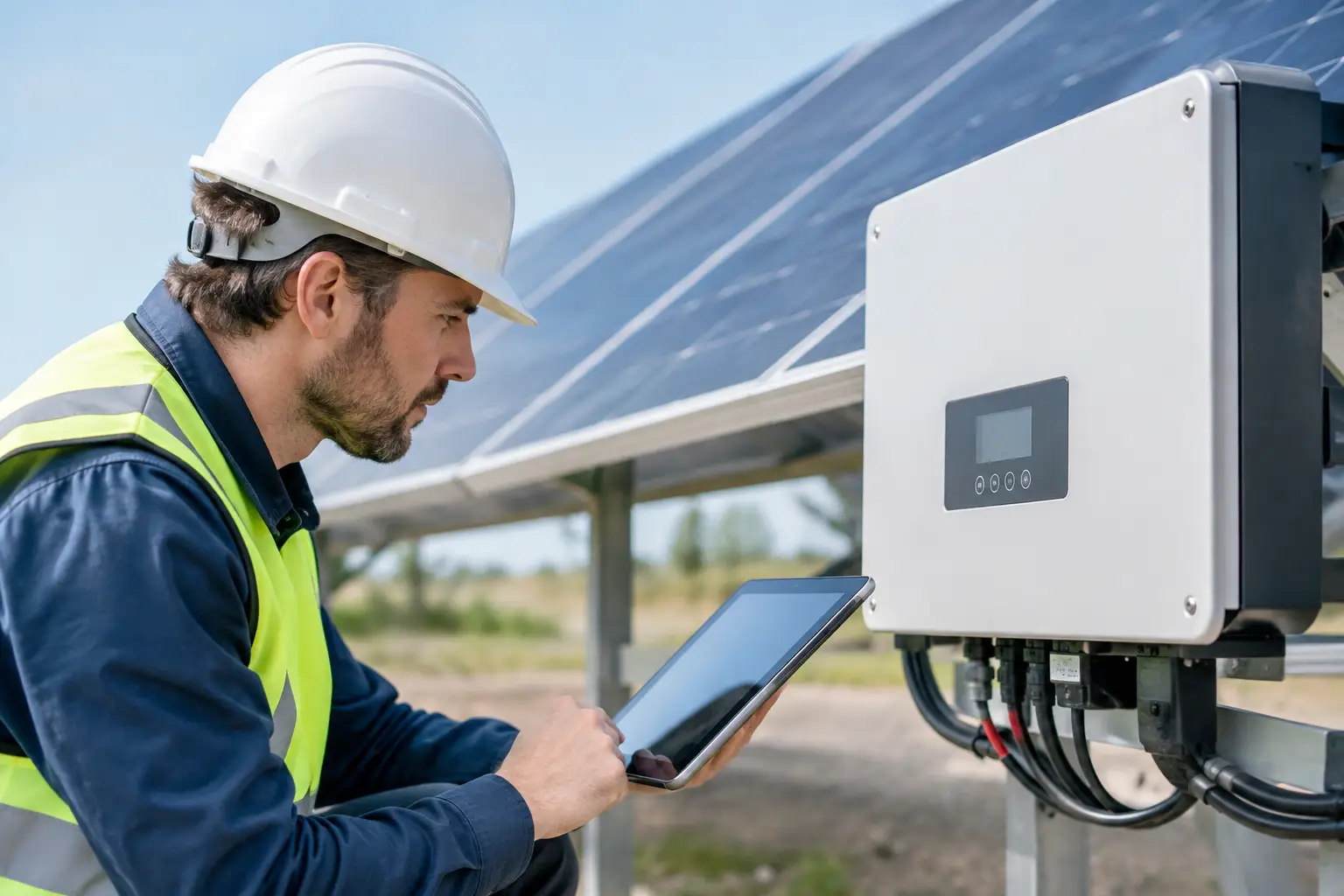
A fault code on the inverter screen can turn a sunny day into a frustrating one. Production may have stopped, an alert may be flashing, and it is rarely clear whether the problem is minor or needs urgent attention. This guide to solar fault codes explains what those messages can tell you, what you can safely check, and when to arrange an electrician-led inspection.
Solar fault codes are not universal. A code that means a grid-voltage issue on one inverter brand may mean something different on another. The code, inverter model, time of day and weather conditions all matter. Treat the display as a useful starting point, not a complete diagnosis.
What a solar fault code is really telling you
Your inverter constantly checks the solar panels, DC cabling, AC supply, internal electronics and grid connection. If a value falls outside its permitted operating range, the inverter may reduce output, disconnect from the grid or shut down entirely. It records a fault, warning or event code to explain why.
Not every message means a failed inverter. Some are temporary grid events. If local voltage or frequency moves outside allowed limits, the inverter must disconnect to protect the network and comply with Australian standards. It may reconnect automatically after the grid has stabilised.
Other codes point to an issue within the solar system itself, such as insulation resistance, an earth fault, a string problem, overheating or a failed component. These require more attention because continuing operation may be unsafe, unreliable or costly in lost generation.
A warning and a fault are also different things. A warning may allow the system to keep generating at a reduced level. A fault commonly stops generation until the condition clears or the inverter is reset and tested. Check the wording on the display or monitoring portal rather than assuming both carry the same urgency.
Common solar fault code categories
The exact label will vary by manufacturer, but most residential systems report faults in a small number of practical categories.
Grid voltage and frequency faults
Messages such as “grid overvoltage”, “grid undervoltage”, “frequency out of range” or “no grid” relate to the AC supply. The inverter is responding to conditions at the switchboard or electricity network, not necessarily a panel fault.
Brief grid messages after a blackout, severe weather or network work may clear without intervention. Repeated overvoltage events, particularly on bright days when your system should be producing well, should be investigated. High voltage at the inverter can cause regular disconnections and reduce your export income even though the panels themselves are healthy.
An electrician can test voltage at the inverter and main switchboard, review cable sizing and connections, and determine whether the issue is internal to the property or needs to be raised with the electricity distributor.
Insulation, earth and leakage faults
Codes mentioning insulation resistance, isolation fault, earth fault, residual current or leakage current need prompt professional assessment. They can be associated with damaged DC cable insulation, water ingress in connectors or isolators, deteriorated panel wiring, pest damage, or moisture after heavy rain.
These faults are not a DIY repair. Solar strings can remain live whenever daylight reaches the panels, even when the inverter is off. Do not open rooftop isolators, unplug solar connectors or remove inverter covers to hunt for the cause.
A qualified solar electrician can carry out insulation resistance testing, inspect DC components and identify the affected circuit without guessing. This is particularly worthwhile on older systems and systems exposed to hail, persistent rain or physical damage.
PV string and low-generation faults
A string fault means the inverter is not receiving the expected voltage or current from one group of panels. The message may refer to low PV voltage, string current, input failure, arc detection or a DC input issue.
The cause could be a loose connection, failed optimiser, blown fuse, damaged cable, failed panel bypass diode or a panel string that has been isolated. Shading can also lower output, but it does not usually explain a persistent fault code by itself.
Compare the inverter’s current output with previous sunny days, allowing for season and weather. If one string is underperforming, total generation may be lower than usual without dropping to zero. Monitoring data is helpful here, but a site inspection and electrical testing are needed to confirm the cause.
Temperature and inverter hardware faults
Over-temperature alerts can occur when an inverter is in direct afternoon sun, has restricted airflow or is working hard during hot conditions. Dust, insects and ageing cooling fans can contribute. If the alert disappears as the day cools, it may still be worth checking ventilation before summer returns.
Internal relay, communication, memory, fan or hardware faults are more likely to need repair or inverter replacement. A restart may clear a one-off communication event, but recurring internal faults should not be managed by repeated resets. Each reset can erase useful evidence and delay a proper diagnosis.
Safe checks to make before booking a repair
Start by photographing the inverter screen. Record the exact fault code, message, date and time. Also note whether the inverter is producing anything, whether the house has recently had a power outage, and whether heavy rain, hail or unusually hot weather occurred before the message appeared.
You can then check the simple, accessible items: is the inverter display on, are the labelled solar supply switches in their normal operating position, and has the main switchboard tripped? Do not touch damaged equipment, do not remove covers, and do not reset a breaker that immediately trips again.
If your monitoring app is available, check whether the fault is a single event or a repeated pattern. A system that disconnects every sunny afternoon tells a different story from one that stopped immediately after a storm. Screenshots of production and fault history can save time during diagnosis.
If there is a burning smell, heat damage, buzzing, visible water ingress, damaged cabling or a repeatedly tripping switch, leave the system off and arrange urgent electrical assessment. Keep clear of rooftop equipment and treat damaged solar wiring as live.
When a reset is reasonable – and when it is not
A controlled inverter restart can be appropriate after a confirmed grid outage or a one-off communications issue, but only if the manufacturer’s instructions for your model are available and there are no signs of damage. Follow the shutdown and restart sequence exactly. Inverters typically require a waiting period before reconnecting to the grid.
Do not reset an inverter to clear insulation, earth, arc, RCD or persistent hardware faults. These are protective functions. Clearing the message without identifying the cause can put the system back into service with an unresolved electrical issue.
It also pays to avoid turning DC isolators on and off unnecessarily. Outdoor isolators are exposed to heat, UV and weather over many years. If an isolator is stiff, cracked, discoloured or showing signs of water ingress, it should be inspected rather than forced.
Why anti-islanding messages need professional testing
Anti-islanding protection ensures a solar inverter stops exporting power when the grid supply fails. This protects line workers and is a mandatory safety function. Some ACT solar owners receive notification that anti-islanding testing is due, while others may see grid-disconnection behaviour that raises questions about compliance.
An anti-islanding test is not simply switching the solar system off and on. It requires the correct test equipment, controlled conditions and a documented result. The electrician verifies that the inverter disconnects within the required limits and that the system returns to normal operation correctly.
If your system has received a testing notice, do not wait for a fault code to appear. Planned testing is generally simpler and less disruptive than finding out the protection function has failed when a wider electrical problem occurs.
Getting a useful diagnosis from a service visit
A proper solar fault investigation should look beyond the code on the screen. The electrician should review inverter history and production performance, test relevant AC and DC circuits, inspect isolators and accessible cabling, and check for weather-related or age-related damage. Where appropriate, panel condition and string performance should be assessed as well.
The outcome should be clear: whether the fault was temporary, what has failed or degraded, what work is required, and whether the system can safely return to service. For repair planning, ask for the practical priority – immediate safety work, generation-restoring repairs, and maintenance items that can be scheduled.
Fault codes are useful because they give an early signal before poor performance becomes months of lost solar savings. Keep a photo of the message, resist the urge to repeatedly reset the system, and arrange qualified testing when the fault persists or involves electrical protection. A clear diagnosis is the quickest path back to safe, dependable generation.
Leave a Reply