

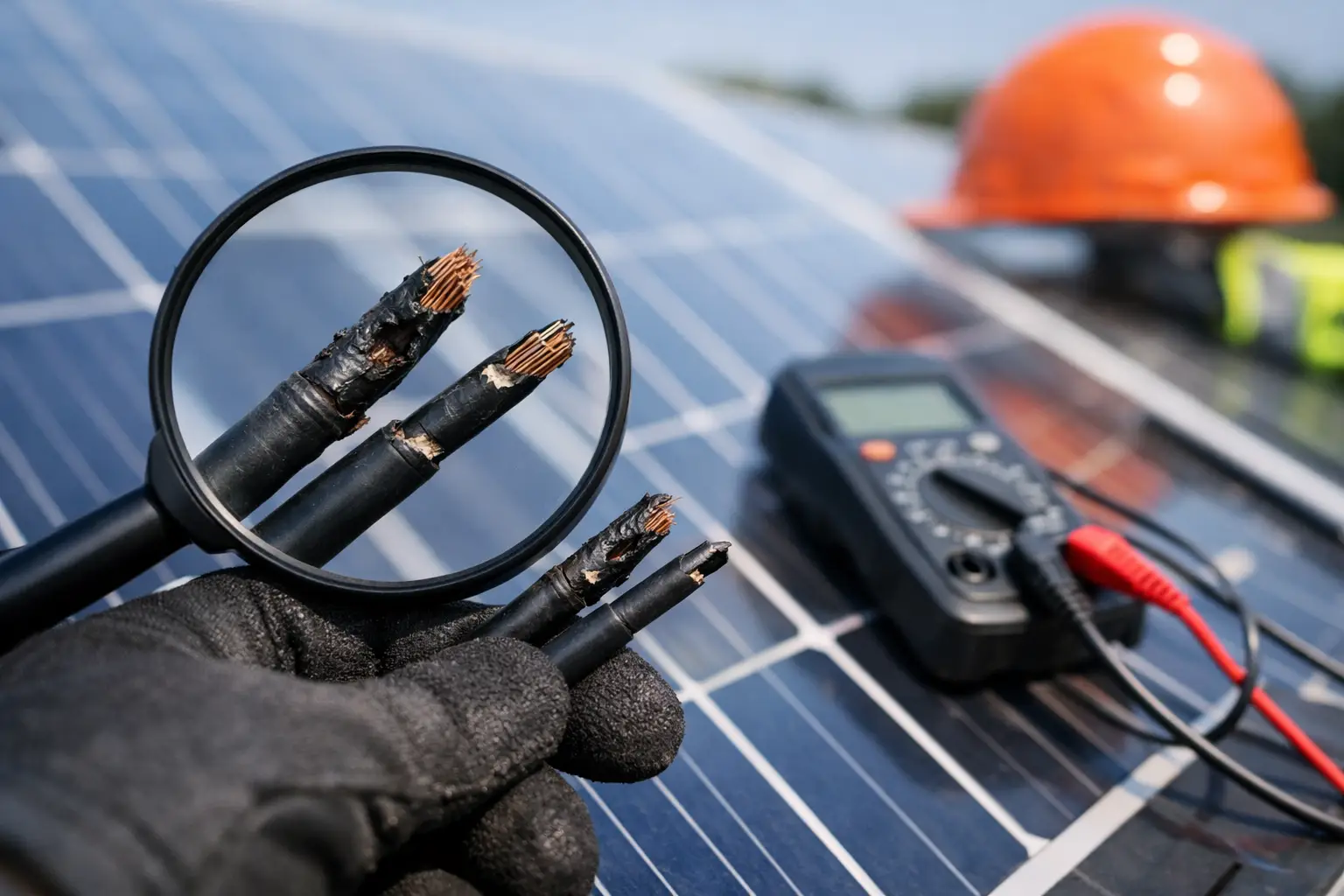
A solar system can look fine from the ground and still have a cable fault costing you generation or creating a safety risk. That is why damaged solar cable inspection matters. Cracked insulation, UV wear, rodent damage, loose terminations and water entry do not always cause an immediate shutdown, but they can lead to poor performance, nuisance tripping, arcing, or more serious electrical faults over time.
For most property owners, the issue is not knowing exactly what has gone wrong. It is knowing when a cable problem is likely, what can be checked safely, and when testing needs to be carried out by a licensed electrician. With rooftop solar, that line matters. Cables carry DC voltage whenever the panels are exposed to light, so inspection needs to be approached with care and with the right test methods.
What damaged solar cable inspection is meant to find
A proper damaged solar cable inspection is not just a quick look under the panels. It is aimed at finding signs of deterioration, mechanical damage, poor installation practice, and age-related faults that affect both safety and output.
On older systems, cable clips can fail and leave solar cable resting against the roof. Over time, movement, heat and abrasion can wear through insulation. On systems exposed to strong sun, plastic components can become brittle. After storms or hail, cable routes and fixings may shift even if the panels themselves appear intact. In some cases, the first visible sign is an inverter fault. In others, the system simply underperforms for months without anyone noticing.
The practical goal of inspection is to work out three things. First, whether there is immediate risk. Second, whether the cable fault is already affecting generation or inverter operation. Third, whether the issue is localised and repairable, or a sign that broader maintenance is needed.
Common signs of solar cable damage
Some cable faults are obvious, but plenty are not. If your inverter is showing repeated errors, intermittent shutdowns or insulation resistance faults, cable condition should be part of the investigation. A sudden drop in output without obvious shading changes can also point to wiring issues, especially on ageing systems.
Visible warning signs include loose or unsupported cable runs, cracked conduit, discoloured insulation, exposed conductors, melted connectors, signs of animal activity, or water staining around cable entry points. On rooftops, cable damage is often found where the original installation left too much slack, where clips have broken, or where cable has been pinched against framing.
It depends on the system layout too. DC cable between the array and inverter is often the higher-risk area because of weather exposure and the nature of DC fault behaviour. AC cabling can also deteriorate, particularly near isolators, switchboards or poorly sealed external fittings.
Why cable faults should not be left alone
A damaged cable is not only a performance issue. It can become a safety and compliance problem. Insulation failure can lead to leakage current, earth faults and arcing. Loose or heat-damaged terminations can worsen under load. Water ingress can travel further than expected and affect nearby components.
There is also a financial angle. A system that is partly down or intermittently faulting may still appear to be operating. Owners often notice the issue only after higher power bills or lower feed-in credits. By then, the repair scope may be larger than it needed to be.
For property owners in the ACT, this matters even more on systems already due for anti-islanding inverter testing or broader condition checks. If testing is already required, it makes sense to confirm the cabling is in good order at the same time rather than treating compliance and system health as separate jobs.
What you can check safely from the ground
There are a few sensible checks a solar owner can make without touching the system. Start with the inverter display or monitoring portal. Look for persistent fault messages, abnormal production trends, or strings dropping out at certain times. Compare current performance against previous periods with similar weather.
From the ground, check for obvious cable sag near the array edge, damaged conduit, displaced rooftop components after storms, and any signs that pests may have been active around the roof space or inverter area. Also look around isolators and the inverter for cracking, discolouration or water exposure.
What you should not do is open isolators, unplug connectors, lift panels, or handle any solar cable yourself. Even a system that is switched off at the inverter can still have live DC present at the array side when the sun is on the panels. That is electrician territory.
How a professional damaged solar cable inspection works
Damaged solar cable inspection by a licensed electrician
A proper inspection starts with visual assessment, but it should not end there. A licensed electrician experienced in solar fault finding will inspect cable routing, support, protection, entry points, connector condition and termination quality. They will also look at the surrounding components because cable issues rarely happen in isolation.
Testing is where the real picture comes through. Depending on the fault symptoms and system design, this can include insulation resistance testing, polarity checks, voltage testing, continuity checks and thermal inspection of terminations and connectors. The aim is to confirm whether the cable damage is cosmetic, performance-related, or an active electrical risk.
On some jobs, the result is straightforward: replace a damaged section, improve cable support, renew degraded conduit, and retest. On others, inspection uncovers a wider pattern such as multiple failed clips, widespread UV deterioration, or water ingress affecting isolators and nearby wiring. That is where experience matters. A patch repair is not the right answer if the rest of the cable run is already near end of life.
Repair versus replacement
Not every damaged cable needs full replacement, but not every fault should be patched either. The right call depends on the cable type, extent of damage, accessibility, age of the system, and whether the surrounding installation still meets current best practice.
If damage is isolated to a clearly defined section and the rest of the run is in sound condition, targeted repair may be practical. If there are repeated wear points, degraded insulation across multiple sections, failed connectors, or evidence of poor original routing, replacement is often the cleaner and more reliable option.
This is one area where cheap fixes can cost more later. A repair that restores operation but leaves the root cause in place can lead to another callout, more downtime and more labour. Good maintenance is not about doing the smallest possible job. It is about doing the right one once.
When to book an inspection
If your system has taken a hit from hail, high wind, rodent activity, roof works or visible ageing, it is worth arranging inspection sooner rather than later. The same applies if the inverter has flagged recurring faults, if generation has dropped without clear reason, or if the system has not had a proper health check in years.
Older systems deserve particular attention. Cable materials, clips, conduits and seals all age, especially on rooftops with long sun exposure. What looked acceptable at installation can become a problem ten or fifteen years later.
For owners already booking anti-islanding testing, adding a system condition inspection is often the practical move. It saves time, gives a clearer view of system health, and helps avoid the situation where compliance is ticked off but an unrelated cable issue keeps dragging performance down.
A sensible approach for solar owners
Solar cable faults are rarely the kind of problem that improve by themselves. They either sit quietly and chip away at output, or they worsen until the system trips, fails testing, or becomes unsafe. A careful inspection gives you a factual starting point – what is damaged, how serious it is, and what should happen next.
That is the value of electrician-led solar maintenance. You get more than a guess from the ground. You get testing, diagnosis and a clear repair path that protects both the system and the return you expect from it.
If you suspect cable damage, treat it as a maintenance issue worth checking properly, not a minor cosmetic defect to keep an eye on. Catching it early is usually simpler, safer and cheaper.
Leave a Reply