


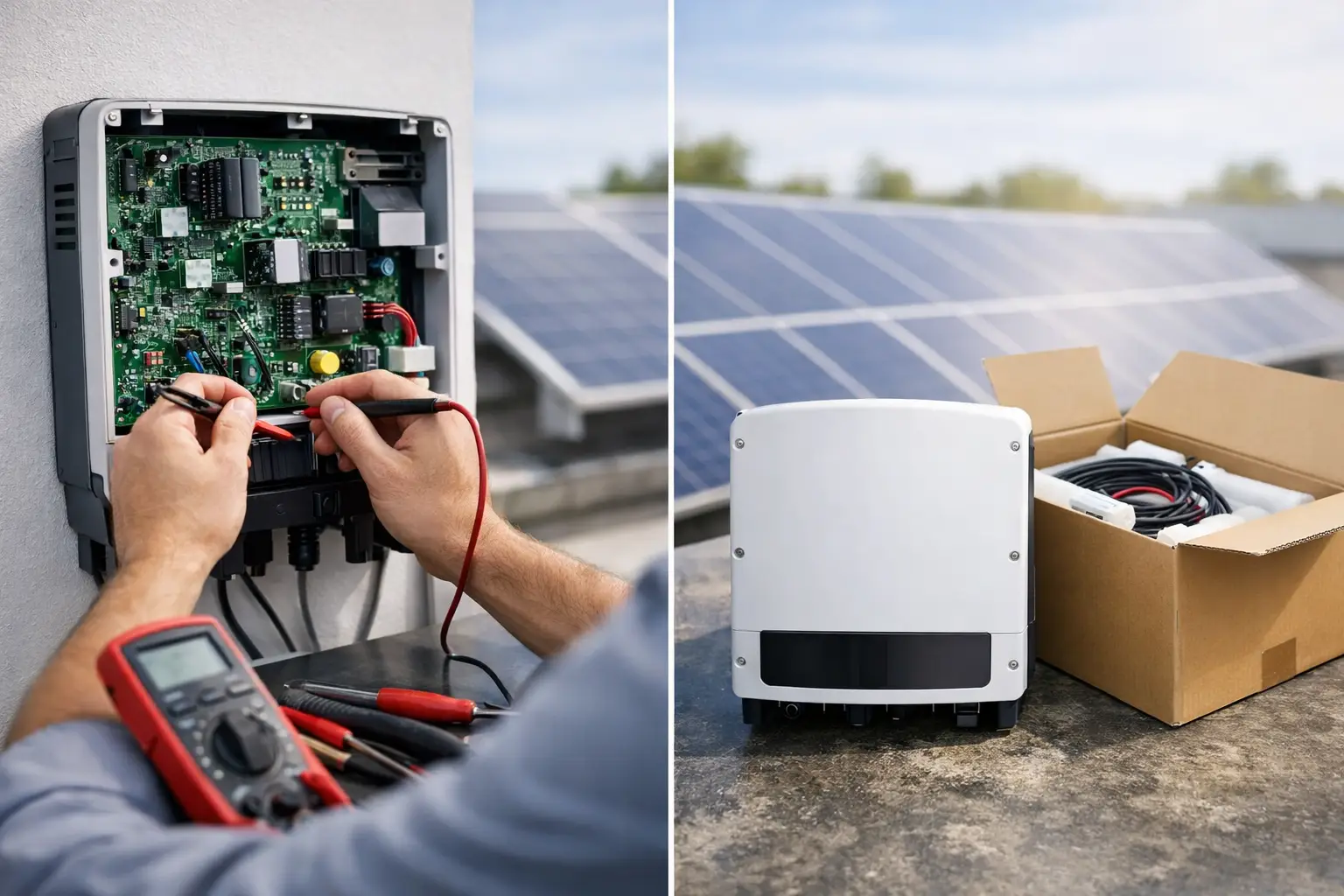
A solar inverter that has stopped producing is not just an equipment problem. Every day it remains offline can mean missed generation, higher grid bills and uncertainty about whether the system is still safe. Inverter repair vs replacement is therefore a financial and compliance decision, not simply a choice between the cheaper quote and the newer unit.
The right answer depends on what has actually failed, the inverter’s age and warranty status, whether parts are available, and the condition of the rest of the solar system. A proper diagnosis comes first. Replacing an inverter without finding the cause of the fault can leave water ingress, damaged cabling, isolator issues or grid connection problems unresolved.
Start with a proper fault diagnosis
An inverter error message is a useful clue, but it is rarely a complete diagnosis. A “grid fault”, “insulation fault” or “no DC input” alert may originate in the inverter itself, but it can also point to a problem elsewhere in the installation.
A qualified solar electrician should assess the inverter’s operating history, visual condition, error codes, DC and AC connections, voltage readings and protective devices. They should also check for signs of heat damage, vermin damage, weather exposure and failed isolators. Where required, anti-islanding testing confirms that the inverter disconnects appropriately when the grid supply is lost.
This work matters particularly for older Canberra systems. Temperature swings, storms and hail can expose weaknesses that were not obvious when the system was first installed. If an inverter has shut down after heavy rain or a hail event, the focus should not be limited to getting it restarted. The source of any moisture or impact damage needs to be identified before the system returns to service.
When inverter repair is the sensible option
Repair can make good financial sense where the fault is specific, safely repairable and the inverter still has worthwhile service life ahead of it. Common examples include failed cooling fans, worn internal components, damaged terminals, communications faults or a failed external isolator rather than a failed inverter.
A repair is also worth considering when the inverter is within its manufacturer’s warranty period. Warranty processes can take time, but they may substantially reduce the cost of the replacement unit or repair. Keep records of fault codes, commissioning details, system serial numbers and service reports, as these may be needed for a claim.
For a relatively young inverter with stable output before the fault, a targeted repair can restore production at a lower upfront cost. The decision should still account for labour, travel, testing and the availability of genuine parts. A low-cost component repair is not automatically good value if repeated call-outs are likely or the manufacturer no longer supports the model.
Repair is most appropriate when the electrician can explain the fault clearly and provide confidence that the rest of the system has been checked. A reset alone is not a repair plan. If an inverter repeatedly trips, loses grid connection or reports an insulation fault, it needs investigation rather than repeated restarting.
Repairs that need caution
Some faults sit in a grey area. For example, an inverter with evidence of water ingress may begin operating again once dry, but internal corrosion can create a later failure or safety risk. Likewise, damage from overheating may affect more than the visibly failed part.
Where internal repairs are proposed for an older unit, ask what warranty is provided on the repair and whether the repair restores full compliance and monitoring functionality. The lowest immediate cost can become the most expensive outcome if it leaves the system unreliable through the next high-generation season.
When inverter replacement is the better investment
Replacement generally becomes the stronger option when an inverter has reached or exceeded its expected working life, has a major internal failure, lacks available parts or has suffered significant weather damage. Many residential inverters operate well for years, but no electronic device lasts indefinitely in an exposed rooftop solar environment.
A new inverter can also be justified where the existing model has a history of recurring faults, poor monitoring support or obsolete grid settings. Modern units may offer improved monitoring, better fault reporting and manufacturer support, which makes future maintenance easier. That said, newer does not automatically mean better for every system. The replacement must be correctly matched to the existing panels, string configuration, grid connection and any battery plans.
Inverter replacement should include confirmation that the DC array is electrically sound. Installing a new inverter onto strings with insulation resistance issues, damaged connectors or poor cable protection may put the new equipment at risk. The job should also include appropriate commissioning, verification of system performance and confirmation that anti-islanding protection is operating as required.
If your system has several inverters, replacing only the failed unit may be sensible. However, it is worth comparing the condition, age and output of the remaining units. A staged replacement plan can be more manageable than waiting for multiple failures, particularly for small commercial properties that rely on predictable solar savings.
Compare the full cost, not just the invoice
The practical way to approach inverter repair vs replacement is to compare the likely cost over the next several years. Repair may have the lower upfront price, while replacement may offer lower risk of downtime and a fresh manufacturer warranty. Neither outcome is automatically right.
Consider the following questions before approving work:
- Is the fault confirmed as an inverter fault, rather than a panel, cable, isolator or grid issue?
- How old is the inverter, and is it still covered by a manufacturer or installer warranty?
- Are genuine parts available, and what warranty applies to the repair?
- Has the inverter failed once, or has it developed a pattern of recurring faults?
- What solar generation will be lost while waiting for parts, a warranty assessment or a new unit?
- Does the proposed solution include electrical testing, commissioning and anti-islanding verification where required?
A clear written recommendation should explain the finding, the work required and the reason repair or replacement has been recommended. This is particularly useful for insurance matters after storm or hail damage. Photos, test results and a description of the affected equipment can help establish whether the issue is limited to the inverter or forms part of a wider system repair.
Do not overlook compliance and safety
An inverter is the control point between your solar array, household switchboard and the electricity network. Any work around it should be completed by a licensed electrician with solar experience. Opening equipment, disconnecting DC plugs or trying to bypass an error code yourself can expose you to dangerous voltages and may affect warranty or insurance coverage.
Grid-connected systems must also continue to meet applicable requirements after repair or replacement. Anti-islanding protection is central to this. It prevents a solar system from continuing to energise wiring when the grid is down, protecting network workers and the property. If you have received an EvoEnergy notification for testing, use the visit as an opportunity to check the wider health of the system rather than treating it as a standalone paperwork exercise.
Make the decision with evidence
The best outcome is not always the fastest repair or the newest inverter. It is the option that safely restores reliable generation, addresses the underlying cause and gives a realistic return for the money spent.
Before committing, arrange a focused system assessment that looks beyond the error message. A tested, documented recommendation gives you a sound basis to repair with confidence, replace only when warranted and keep your solar investment producing as it should.
Leave a Reply